AI WhatsApp 0300 087 4232

META TITLE: Carpal Tunnel Syndrome Explained | Pakistan Guide
META DESCRIPTION: Carpal tunnel Pakistan guide by neurosurgeon Dr Wasif Rizwan Malik: causes, symptoms, diagnosis & treatment. Evidence-based care at Faraz Hospital Bahawalpur.
Carpal Tunnel Syndrome Explained: Complete Guide for Patients in Pakistan
Author: Dr. Wasif Rizwan Malik | MBBS, FCPS (Neurosurgery) | PMDC 47983-P | Consultant Neurosurgeon, Faraz Hospital, Dubai Mahal Chowk, Bahawalpur
Introduction
Carpal tunnel syndrome (CTS) is the most common entrapment neuropathy worldwide and a frequent reason patients seek care for hand numbness in Pakistan. Population studies show a general-population prevalence of roughly 3–6%, with women affected about three times more often than men and peak incidence between ages 40 and 60; lifetime risk approaches 10% in some cohorts, and more than half of cases are bilateral. In Pakistan, CTS is regularly seen among manual labourers, computer and office workers, housewives performing repetitive household tasks, and people with diabetes or other metabolic conditions. Delayed presentation is common outside major cities because electrodiagnostic testing is not always readily available and many patients first try home remedies. Early recognition matters: untreated median-nerve compression can progress from intermittent tingling to permanent sensory loss and thenar muscle wasting. This article explains the condition in plain language, outlines evidence-based diagnosis and treatment, and describes how we evaluate and manage CTS at Faraz Hospital, Bahawalpur, so patients and families can make informed decisions.
What is it?
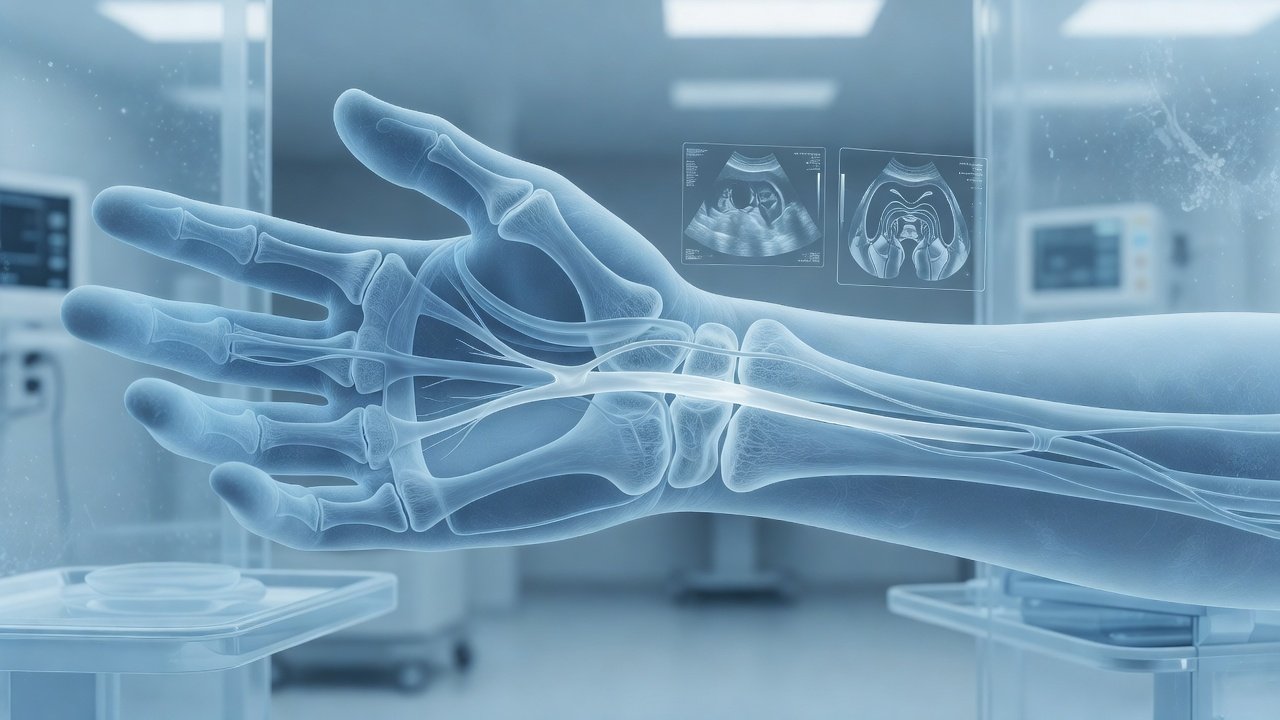
Carpal tunnel syndrome is compression of the median nerve as it travels through the carpal tunnel—a narrow fibro-osseous canal at the wrist formed by the carpal bones and the transverse carpal ligament. Inside this confined space run the median nerve and the nine flexor tendons to the fingers and thumb. Any increase in pressure (from swelling, thickening of the ligament, fluid retention, or space-occupying lesions) reduces blood flow to the nerve and impairs axonal conduction. The result is the classic sensory symptoms in the thumb, index, middle, and radial half of the ring finger, and, in more advanced cases, weakness of the thenar muscles (abductor pollicis brevis, opponens pollicis, and flexor pollicis brevis). CTS is classified as an entrapment neuropathy; it is distinct from cervical radiculopathy, peripheral neuropathy, or thoracic-outlet syndromes, although these can coexist or mimic it. Because the median nerve supplies critical sensation for fine pinch and grip, even moderate CTS can interfere with writing, buttoning clothes, holding a phone, or performing skilled manual work—activities central to daily life and livelihood for many Pakistanis. Understanding the anatomy helps patients appreciate why night-time symptoms are common (wrist flexion during sleep further narrows the tunnel) and why simple wrist positioning can relieve pressure.
Causes
CTS develops when the volume of the carpal tunnel contents exceeds the fixed space available, raising interstitial pressure. Risk factors include repetitive or forceful hand use (common in factory work, sewing, computer data entry, and household chores), obesity, diabetes mellitus, pregnancy (fluid retention), rheumatoid arthritis and other inflammatory arthropathies, hypothyroidism, and prior wrist fracture or trauma. Anatomical variants, ganglion cysts, or tenosynovitis can also contribute. In Pakistan the occupational burden is substantial: prolonged smartphone or computer use, manual labour without ergonomic breaks, and high rates of undiagnosed or poorly controlled diabetes amplify risk. Women are more susceptible, partly because of smaller tunnel dimensions and hormonal influences. Bilateral disease is frequent, especially when systemic factors (metabolic or inflammatory) predominate. Not every person with risk factors develops CTS; individual susceptibility, cumulative exposure, and local anatomy interact. Identifying and modifying reversible contributors—weight reduction, better glycaemic control, activity pacing—is an essential part of first-line care and can reduce the need for surgery in milder cases.
Symptoms – bold red flags
Typical early symptoms are intermittent numbness, tingling, or “pins-and-needles” in the thumb, index, middle, and radial ring finger, often worse at night or on waking. Patients may shake the hand for relief (the classic flick sign). Daytime symptoms appear with sustained grip or wrist flexion—driving, holding a phone, reading, or working at a keyboard. Pain can radiate into the forearm or, less often, the shoulder. As compression worsens, numbness becomes constant, fine motor control declines, and objects are dropped. Advanced disease produces thenar atrophy (visible flattening of the muscle bulk at the base of the thumb) and weakness of thumb opposition and abduction.
Red flags that warrant prompt specialist review:
– Constant numbness or progressive sensory loss
– Thenar muscle wasting or clear weakness of thumb opposition
– Symptoms that wake the patient nightly and no longer respond to splinting
– Bilateral severe symptoms with functional impairment (inability to button, write, or grip)
– Sudden worsening after injury or in the setting of known space-occupying lesion
– Associated neck pain, arm weakness in other distributions, or signs suggesting cervical radiculopathy or polyneuropathy (these require broader neurological evaluation)
Do not ignore progressive deficits; irreversible axonal loss can occur if severe compression continues unchecked. In pregnancy, symptoms often improve after delivery, but persistent postnatal deficits still need assessment.
Diagnosis at Faraz Hospital
Diagnosis begins with a focused history and clinical examination: distribution of sensory symptoms, Tinel’s sign at the wrist, Phalen’s manoeuvre, and assessment of thenar bulk and strength. We carefully differentiate CTS from cervical radiculopathy, pronator syndrome, ulnar neuropathy, and polyneuropathy. When the diagnosis is uncertain, symptoms are severe, or surgery is being considered, electrodiagnostic studies (nerve-conduction studies and EMG) are the reference standard recommended by major guidelines to confirm median-nerve compression at the wrist, grade severity, and exclude competing diagnoses. At Faraz Hospital we arrange or review high-quality NCS/EMG and integrate the results with clinical findings. Imaging is not routine for typical CTS but may be used selectively if a mass, fracture, or atypical feature is suspected; our facility’s advanced imaging capability, including BodyTom CT when indicated for complex wrist or associated pathology, supports precise anatomical clarification. Shared decision-making is central: we explain severity, natural history, and options so each patient understands the rationale for conservative care versus decompression.
Treatment
High-quality guidelines (AAN/AAEM practice parameter and NICE pathways) support a stepped approach. For mild-to-moderate CTS we begin with activity modification, ergonomic advice, and night-time wrist splinting in neutral position; many patients improve substantially. A single corticosteroid injection into the carpal tunnel can provide months of relief and is useful both therapeutically and diagnostically. Oral medications have limited long-term role; we address comorbidities such as diabetes and thyroid disease. When symptoms persist despite adequate conservative care, or when there is thenar weakness, atrophy, or electrodiagnostic evidence of severe axonal loss, surgical decompression (carpal tunnel release) is indicated. Both open and endoscopic techniques divide the transverse carpal ligament and reliably relieve pressure; choice depends on anatomy, surgeon experience, and patient factors. At Faraz Hospital, carpal-tunnel release is performed with meticulous microsurgical technique under appropriate magnification (Zeiss microscope available for precision work when needed) and with full attention to the recurrent motor branch and surrounding structures. BodyTom CT can assist preoperative planning in selected complex or revision cases. Evidence shows high rates of symptom resolution and patient satisfaction when diagnosis is accurate and timing is appropriate; we discuss realistic expectations, including that severe preoperative axonal loss may leave residual numbness even after successful decompression. Surgery is day-case or short-stay for most patients; we emphasise shared decision-making on timing rather than rushing every case to the operating theatre.
Recovery
After release, night pain and tingling often improve within days to weeks as pressure on the nerve falls. Wound healing typically allows light hand use within 1–2 weeks and progressive return to heavier activity over 4–6 weeks, guided by the individual’s occupation and the presence of thenar weakness. Formal physiotherapy is not always required but is helpful for stiffness, scar desensitisation, and strengthening when atrophy has occurred. Full sensory recovery can take months if the nerve was severely compressed; patients with long-standing constant numbness are counselled that some deficit may persist. We provide clear written after-care instructions, wound review, and follow-up to monitor progress and address any pillar pain or scar sensitivity. Return-to-work planning is individualised—office workers often resume sooner than those performing heavy manual labour. Long-term outcome is excellent for the majority when surgery is performed for the correct indications; recurrence is uncommon but possible, especially if systemic risk factors remain uncontrolled.
FAQ
1. Is carpal tunnel syndrome common in Pakistan?
Yes. It is frequently reported among manual workers, computer users, housewives, and people with diabetes. Local patterns show delayed presentation and variable access to electrodiagnostics outside larger centres, making awareness and early conservative care especially important.
2. Do I always need surgery?
No. Many patients improve with night splints, activity changes, and a steroid injection. Surgery is reserved for persistent, progressive, or severe cases with weakness or failed non-operative care.
3. How is CTS confirmed?
Clinical diagnosis is often sufficient for typical cases. Nerve-conduction studies/EMG confirm the site and severity of median-nerve compression and are recommended when the picture is unclear or surgery is planned.
4. Can CTS come back after surgery?
True recurrence is uncommon after complete ligament release. Persistent or new symptoms may reflect incomplete release, concurrent neuropathy, or ongoing risk factors; proper diagnosis and technique minimise this risk.
5. When should I see a neurosurgeon in Bahawalpur?
Seek review for night symptoms that disturb sleep, constant numbness, dropping objects, visible thenar wasting, or failure of splinting/injection. Early specialist input prevents permanent nerve damage.
Conclusion + CTA
Carpal tunnel syndrome is treatable at every stage. Accurate clinical and electrodiagnostic assessment, timely conservative measures, and precise surgical decompression when needed restore comfort and hand function for the large majority of patients. In Pakistan, combining occupational awareness, metabolic control, and access to specialist care is the most effective strategy. If you or a family member have symptoms suggestive of CTS, do not wait for permanent numbness or weakness.
Book online: https://rx.drwasifmalik.com
AI WhatsApp (booking & PA, no diagnosis, no imaging brief): https://wa.me/923000874232 (0300 087 4232)
Emergency direct Dr Wasif (not routine booking): tel:+923458254232 (0345 825 4232)
Faraz Hospital, Dubai Mahal Chowk, Bahawalpur
References (PubMed PMIDs verified as existing)
– American Association of Electrodiagnostic Medicine, American Academy of Neurology, American Academy of Physical Medicine and Rehabilitation. Practice parameter for electrodiagnostic studies in carpal tunnel syndrome. Neurology. 2002;58(11):1589-1592. PMID: 12058176.
– Atroshi I, Gummesson C, Johnsson R, Ornstein E, Ranstam J, Rosén I. Prevalence of carpal tunnel syndrome in a general population. JAMA. 1999;282(2):153-158. PMID: 10367871.
– Related high-level evidence synthesis on diagnosis and management: PMID 21976544.
Author: Dr. Wasif Rizwan Malik | MBBS, FCPS (Neurosurgery) | PMDC 47983-P | Consultant Neurosurgeon, Faraz Hospital, Dubai Mahal Chowk, Bahawalpur
Book online: https://rx.drwasifmalik.com | AI WhatsApp (booking & PA, no diagnosis, no imaging brief): https://wa.me/923000874232 (0300 087 4232) | Emergency direct Dr Wasif (not routine booking): tel:+923458254232 (0345 825 4232) | Faraz Hospital, Bahawalpur
Disclaimer: This article is for educational purposes only and does not constitute personalised medical advice, diagnosis, or treatment. Always consult a qualified physician for individual assessment. Electrodiagnostic testing, imaging, and surgical decisions must be made in the clinical context by the treating specialist.
Published by: Dr. Wasif Rizwan Malik
Credentials: MBBS, FCPS (Neurosurgery), PMDC 47983-P